WBHRB CBT vs Previous Recruitment System: What Nursing and Healthcare Candidates Should Know
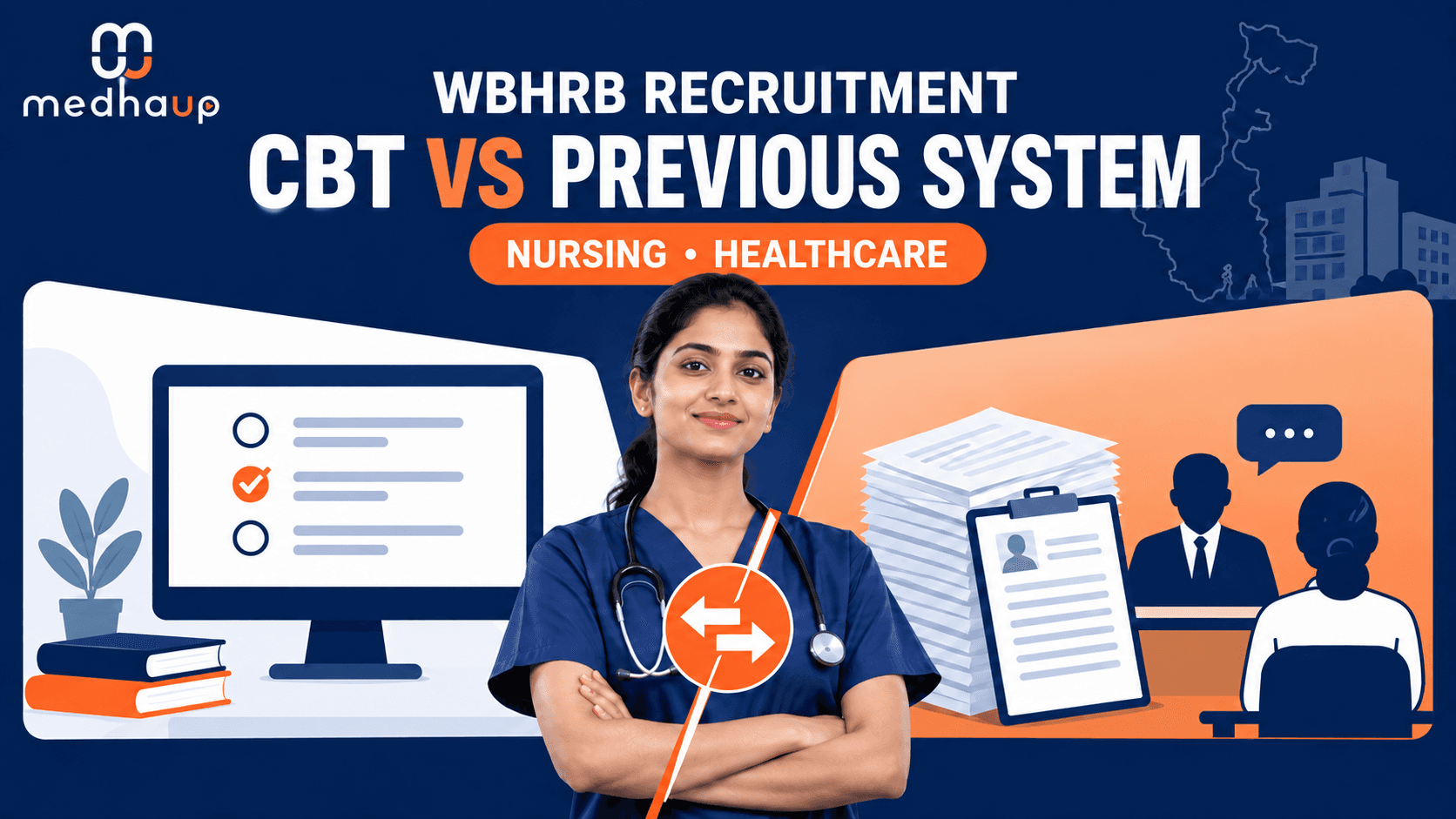
The West Bengal Health Recruitment Board (WBHRB) made a major change in its recruitment method for several large healthcare recruitments, including Staff Nurse Grade-II, Pharmacist Grade-III, Medical Technologist Grade-III and General Duty Medical Officer (GDMO).
When the original advertisements were issued on 7 August 2025, candidates were largely expected to be assessed through a combination of:
- Academic qualification
- Relevant work experience
- Interview
However, on 3 November 2025, WBHRB officially changed the selection method for six major recruitment advertisements and introduced a Computer Based Test (CBT).
The revised system became:
CBT — 85 Marks
plus:
Interview — 15 Marks
for a total of:
100 Marks
Most importantly, WBHRB stated that no further marks would be awarded for qualification and experience under those recruitments once the CBT system was introduced.
This change completely altered how candidates needed to prepare for WBHRB recruitment.
WBHRB Old System vs CBT System: Quick Comparison
Point| Original/Previous System| Revised CBT System Main selection basis| Academic marks + experience + interview| CBT + interview Written/CBT exam| Not initially the main scoring component| Major selection component CBT Weightage| Not applicable initially| 85 marks Interview| Usually 15 marks| 15 marks Academic Marks| Directly contributed to merit| No separate marks Experience Marks| Could directly contribute| No separate marks Negative Marking| Not relevant| Yes: −0.5 Multiple Shifts| Not relevant| Normalisation possible Candidate Strategy| Documents + academic record + experience| Subject knowledge + speed + accuracy + interview Fresh Graduate Position| Could be weaker if experience carried marks| Better chance through strong CBT performance Experienced Candidate Position| Could gain direct experience marks| Experience alone gives no separate merit marks
Which WBHRB Recruitments Were Shifted to CBT?
The WBHRB notice dated 3 November 2025 applied the revised CBT system to the following advertisements:
- GDMO — Advertisement No. R/GDMO/6/2025
- Staff Nurse Grade-II GNM — R/Staff Nurses, Gr. II/GNM/7/2025
- Staff Nurse Basic & Post Basic B.Sc. Nursing — R/Staff Nurses, Gr. II/Basic & Post Basic B.Sc. Nursing/8/2025
- Medical Technologist Grade-III — various disciplines under Advertisement 9/2025
- Medical Technologist OT/Critical Care Special Drive — Advertisement 10/2025
- Pharmacist Grade-III — Advertisement 11/2025
WBHRB specifically said the CBT would be used for shortlisting candidates for interview and preparation of the Overall Performance List.
What Was the Previous Staff Nurse Selection System?
The original GNM Staff Nurse advertisement gave:
Academic Marks — 75
Experience — 10
Interview — 15
Total:
100 Marks
The academic component itself included marks based on qualifications such as Higher Secondary, GNM and an optional clinical-speciality diploma. Relevant experience in Government or private healthcare facilities could contribute up to 10 marks.
Original GNM Staff Nurse Structure
Component| Marks Academic Qualification| 75 Relevant Experience| 10 Interview| 15 Total| 100
Under that original structure, a candidate with stronger academic marks and several years of relevant experience could enter the interview stage with a built-in advantage.
How Were Experience Marks Awarded Earlier?
For GNM Staff Nurse, the original advertisement gave experience marks approximately as follows:
Relevant Experience| Marks Less than 12 months| 0 12 to <24 months| 2 24 to <36 months| 4 36 to <48 months| 6 48 to <60 months| 8 60 months or more| 10
The advertisement specifically recognised relevant experience in a Government or private healthcare facility.
However:
Experience was not the same as essential eligibility.
A fresh eligible GNM candidate could still apply, but an experienced candidate could originally gain more merit marks.
What Changed for Staff Nurse After CBT Was Introduced?
Once the revised CBT system came into effect:
Academic Marks — no separate final merit marks
Experience Marks — no separate final merit marks
CBT — 85
Interview — 15
WBHRB explicitly stated that no further marks would be allotted for “Qualification” and “Experience” under the revised system.
This was a major shift.
A candidate with:
- 90% academic marks
- Five years' hospital experience
would no longer automatically receive a large scoring advantage over a fresher simply because of those factors.
Both would need to perform strongly in the CBT.
What Was the Previous Pharmacist Selection System?
The original Pharmacist Grade-III advertisement also used:
Academic Marks — 75
Experience — 10
Interview — 15
The academic scoring recognised the required Higher Secondary and pharmacy qualification, while experience as an “A” Category Pharmacist in eligible Government/private institutions or healthcare establishments could earn additional marks.
Under the revised November 2025 system, those separate qualification and experience marks were replaced by the:
85-mark CBT + 15-mark Interview
structure.
What Was the Previous Medical Technologist System?
The original Medical Technologist Grade-III recruitment similarly used:
Academic Marks — 75
Experience Marks — 10
Interview — 15
Academic scoring differed depending on whether the candidate held the relevant Medical Technology degree or diploma, but academic qualification directly contributed to merit under the original advertisement.
After WBHRB's November revision, Medical Technologist candidates also moved to:
CBT — 85
Interview — 15
with no separate qualification/experience marks.
GDMO Was Slightly Different Under the Previous System
GDMO originally had a somewhat different marks structure.
The August 2025 advertisement provided:
Component| Marks Academic Qualification| 70 Experience| 15 Interview| 15 Total| 100
It also included academic scoring linked to MBBS/FMG examination performance and relevant experience as a doctor.
After the November 3 decision, even GDMO recruitment moved to:
CBT 85 + Interview 15
with the previous qualification/experience merit scoring removed for that recruitment.
New WBHRB CBT Exam Pattern
The common CBT scheme introduced by WBHRB had:
50 MCQs
carrying:
100 raw marks
with:
2 marks for each correct answer
and:
−0.5 mark for each incorrect answer
Duration:
60 Minutes
WBHRB then converted the raw CBT score out of 100 to a maximum contribution of:
85 Marks
for the final selection process.
CBT Marks Calculation
The basic raw score formula is:
Raw CBT Score = (Correct × 2) − (Wrong × 0.5)
Example
Suppose a candidate answers:
- 38 correct
- 6 wrong
- 6 unattempted
Correct-answer marks:
38 × 2 = 76
Negative marking:
6 × 0.5 = 3
Raw CBT Score:
73/100
If no separate normalisation issue applies, the approximate converted component becomes:
73 × 0.85
=
62.05/85
The remaining maximum:
15 marks
comes from the interview.
Normalisation: Another Major Difference
Under the old marks-based system, candidates did not need to think about exam-shift normalisation.
Under CBT, WBHRB states that marks can be:
Normalised when the CBT is conducted in more than one shift.
The GNM Staff Nurse examination was in fact conducted across multiple shifts on 31 December 2025 and 1 January 2026.
Later, WBHRB's GNM scorecard showed:
- Raw marks out of 100
- Pro-rated raw marks out of 85
- Normalized marks
- Category-wise minimum score of the last candidate shortlisted for interview.
This means candidates should not compare raw marks across shifts without considering normalisation.
Why Did This Change Matter So Much for Fresh Candidates?
Under the earlier Staff Nurse system, experience could contribute:
Up to 10 marks.
A fresher would generally receive:
0 experience marks.
Someone with five or more years of relevant experience could receive the full:
10 marks.
Under the CBT model:
Both candidates begin with the same examination opportunity.
The experienced candidate can still benefit from practical knowledge during the CBT or interview, but no automatic separate experience marks are added under the revised scheme.
For fresh GNM/B.Sc. candidates, this makes exam preparation much more important.
Does This Mean Experience Has Become Useless?
No.
This is an important distinction.
WBHRB removed separate merit marks for qualification and experience in the affected recruitments.
That does not mean:
- Qualification is unnecessary
- Professional registration is unnecessary
- Required experience can be ignored where it forms essential eligibility
- Documents do not matter
Candidates still need to satisfy every essential eligibility rule.
For Staff Nurse, for example, valid nursing qualification and the required WBNC registration remained essential. The 2025 corrigendum required the prescribed valid WBNC registration/reciprocal registration to exist on the specified eligibility date.
So:
“No marks for qualification” does NOT mean “qualification doesn't matter.”
Qualification determines whether you are eligible to compete.
CBT determines much more of the merit.
Does Academic Percentage Still Matter?
Under the revised selection formula for these particular recruitments:
It does not receive a separate merit component.
A candidate with:
80% in GNM
and a candidate with:
65% in GNM
can both compete through CBT if both satisfy all essential eligibility requirements.
The candidate who performs better in the CBT can ultimately have the stronger merit position.
That is very different from the original marks-based recruitment structure.
Old System vs New System: Example
Consider two hypothetical GNM candidates.
Candidate A
- GNM marks: very high
- Five years' hospital experience
- Average CBT knowledge
Candidate B
- Average GNM percentage
- Fresher
- Excellent nursing concepts and CBT preparation
Under the original system
Candidate A could gain a significant advantage from:
- Academic score
- Experience marks
before interview.
Under the revised CBT system
Candidate B can potentially move ahead through a much stronger CBT score.
This illustrates why preparation strategy has changed dramatically.
What Has Not Changed?
Although the scoring method changed, several things remain extremely important.
Candidates still need:
- Correct educational qualification
- Valid professional registration
- Correct category documents
- Age eligibility
- Appropriate certificates
- Accurate application information
- Interview preparation
- Final eligibility verification
WBHRB's Staff Nurse advertisement also made clear that candidature remains provisional and the Board may request original certificates or additional proof when necessary.
Document Verification Is Still Important
One wrong assumption is:
«“Since academic marks are no longer counted, WBHRB won't check marksheets.”»
That is incorrect.
Academic documents still prove:
whether the candidate possesses the essential qualification.
Professional registration proves eligibility.
Category certificates establish reservation claims.
Experience certificates may still be relevant where experience is essential or otherwise requested.
WBHRB can ask candidates for additional particulars or original documents and can reject candidature if the required evidence is not produced.
The Candidate's Priority Has Shifted
Under the older system, a candidate's recruitment strength was largely built over years through:
- Academic percentage
- Qualification
- Experience
Under CBT, much more depends on:
- Subject knowledge
- Current preparation
- Speed
- Accuracy
- Understanding MCQs
- Clinical reasoning
- Negative-marking control
- Interview performance
That makes exam-oriented preparation essential.
What Nursing Candidates Should Change in Their Preparation
For GNM and B.Sc. Nursing candidates, simply reading nursing notes casually is no longer enough.
The latest Staff Nurse CBT used a professional nursing syllabus and tested areas including:
- Nursing Foundation
- Medical-Surgical / Adult Health Nursing
- Midwifery & Gynaecology
- Community Health Nursing
- Child Health Nursing
- Mental Health Nursing
- Anatomy/Physiology
- Microbiology
- Nutrition
- Pharmacology where applicable
- Nursing Management
- Research-related concepts
The latest GNM answer-key structure confirms the paper was composed of nursing-subject MCQs rather than a generic general-knowledge test.
Nursing Candidates Should Practise the Exact CBT Format
If the same pattern is used again, candidates should practise:
50 Questions in 60 Minutes
with:
+2 correct
−0.5 wrong
This means candidates get an average of:
72 seconds per question.
Preparation should therefore combine:
Concept revision + timed MCQs.
What Pharmacist Candidates Should Do Differently
Under the revised system, Pharmacist candidates should focus heavily on the official professional syllabus.
WBHRB's Pharmacist CBT syllabus was based on the Diploma in Pharmacy Curriculum & Syllabus under Pharmacy Council of India Education Regulation 2020, including areas such as:
- Pharmaceutics
- Pharmaceutical Chemistry
- Pharmacognosy
- Human Anatomy & Physiology
- Social Pharmacy
- Pharmacology
- Community Pharmacy & Management
- Pharmacotherapeutics.
For pharmacy candidates, high B.Pharm/D.Pharm marks alone no longer guarantee a major merit advantage under the revised recruitment model.
What Medical Technologist Candidates Should Do
Medical Technologists should prepare according to their exact speciality.
For example:
- Radiodiagnosis
- ECG
- Dialysis
- Perfusion
- Cath Lab
- EEG/EMG
- Radiotherapy
- Operation Theatre
- Critical Care
can require different technical knowledge.
The previous academic system rewarded qualification marks directly, but the CBT model puts much more importance on actually answering technical questions correctly on exam day.
What GDMO Candidates Should Understand
GDMO candidates experienced one of the biggest changes.
The original GDMO system provided:
Academic — 70
Experience — 15
Interview — 15.
That meant MBBS/FMGE performance and experience could significantly influence merit.
After the CBT change:
CBT — 85
Interview — 15
with no separate marks for academic score or experience.
Therefore doctors preparing for future similar recruitments should not assume that MBBS percentage alone will carry them through.
Is the CBT System Better for Freshers?
From a competitive point of view:
It can create a stronger opportunity for well-prepared freshers.
A fresher may not have five years of experience, but can still earn a high CBT score.
However, this does not necessarily make the exam easier.
CBT also creates:
- Larger direct competition
- Negative marking
- Time pressure
- Shift-normalisation issues
- Need for deeper syllabus preparation
So freshers gain opportunity—but must earn it through exam performance.
Is the CBT System Worse for Experienced Candidates?
Not necessarily.
Experienced nurses, pharmacists, technologists and doctors may have:
- Strong clinical understanding
- Better practical judgement
- Familiarity with healthcare procedures
- Greater confidence in interviews
These can help substantially.
What changed is that experience no longer provided an automatic separate marks block in the affected recruitment.
Experienced candidates now also need strong exam preparation.
Negative Marking Changes Candidate Behaviour
Under the latest CBT:
Wrong answer = −0.5
Four wrong answers cost:
2 marks
which cancels the marks earned from one correct answer.
For example:
35 correct = 70
10 wrong = −5
Final:
65
instead of 70.
Therefore, candidates cannot rely on random guessing.
CBT Requires Different Study Material
For the previous academic/experience model, many candidates focused mainly on:
- Ensuring documents were correct
- Calculating academic scores
- Building experience marks
- Interview preparation
Under CBT, candidates also need:
- Official syllabus
- Subject-wise MCQs
- Previous question patterns
- Mock tests
- Timed practice
- Error analysis
- Revision schedules
The recruitment process has effectively become much more exam-oriented.
Interview Still Matters
Even though CBT carries:
85%
of the final score,
the interview still contributes:
15%.
That can affect borderline candidates significantly.
Example:
Candidate| CBT| Interview| Total A| 65| 5| 70 B| 61| 12| 73
Candidate B can overtake Candidate A despite the lower CBT score.
So candidates should not stop preparing after clearing the CBT.
Why Academic Certificates Still Need to Be Perfect
Under the new system:
Academic marks may not earn merit points,
but:
academic certificates remain eligibility documents.
For example, WBHRB's GNM advertisement required recognised GNM qualification and WBNC registration, while the Board reserved the right to seek proof and reject a candidate unable to substantiate eligibility.
Therefore, candidates should still carefully upload:
- Correct marksheets
- Pass certificates
- Registration certificate
- Conversion sheet where required
- Category documents
- Experience proof if requested
- Other post-specific documents
Old System Favoured Long-Term Profile; CBT Rewards Current Performance
The simplest way to understand the difference is:
Previous system
Your past record had a major role.
Academic marks + experience + interview.
CBT system
Your current competitive performance has the dominant role.
CBT + interview.
This is the biggest strategic change candidates need to understand.
Does WBHRB Now Always Use CBT?
No.
This is extremely important.
The November 3 CBT notice applied specifically to the six advertisements listed in that notice.
WBHRB recruits many other posts, including:
- Specialist doctors
- Faculty posts
- Administrative posts
- Other technical and healthcare positions
Those recruitments can use different selection systems.
So candidates should not assume:
«“Every future WBHRB vacancy will definitely have 50 MCQs.”»
That is not confirmed.
Will the Next Staff Nurse Recruitment Also Have CBT?
It is quite possible, but not guaranteed until WBHRB publishes the next official selection notice.
The latest major Staff Nurse recruitment successfully used:
- CBT
- Interview
- Normalisation where applicable
- Final panel preparation
which makes it a useful preparation reference.
But WBHRB's own advertisement framework allowed the Board to decide later whether to conduct a written exam/CBT and to revise the marks distribution accordingly.
Therefore:
Prepare for CBT now.
But:
Check the new advertisement and every corrigendum before treating the pattern as final.
How Candidates Should Prepare Going Forward
A practical strategy is:
- Secure Eligibility First
Make sure your professional registration and qualification are complete.
- Download the Official Syllabus
Do not depend solely on coaching-site syllabus lists.
- Build Concepts
Understand the professional subjects thoroughly.
- Practise Topic-Wise MCQs
Immediately after each chapter.
- Start Full CBT Mocks
Use:
50 Questions / 60 Minutes / +2 / −0.5
if preparing on the latest pattern.
- Track Accuracy
Aim for strong accuracy rather than merely attempting every question.
- Prepare for Interview
Begin interview preparation immediately after CBT—not after results.
- Keep Documents Updated
Exam performance cannot save an ineligible application.
Common Myths About the New WBHRB CBT System
Myth 1: Academic Marks No Longer Matter at All
Wrong.
They may no longer receive separate merit marks under the revised system, but academic qualification remains essential for e
Have a question about your preparation?
Message us on WhatsApp — Bengali or English, we reply the same day.
Chat on WhatsApp