Top 50 General Science MCQs for SSC, Railway, Nursing & Government Job Exams
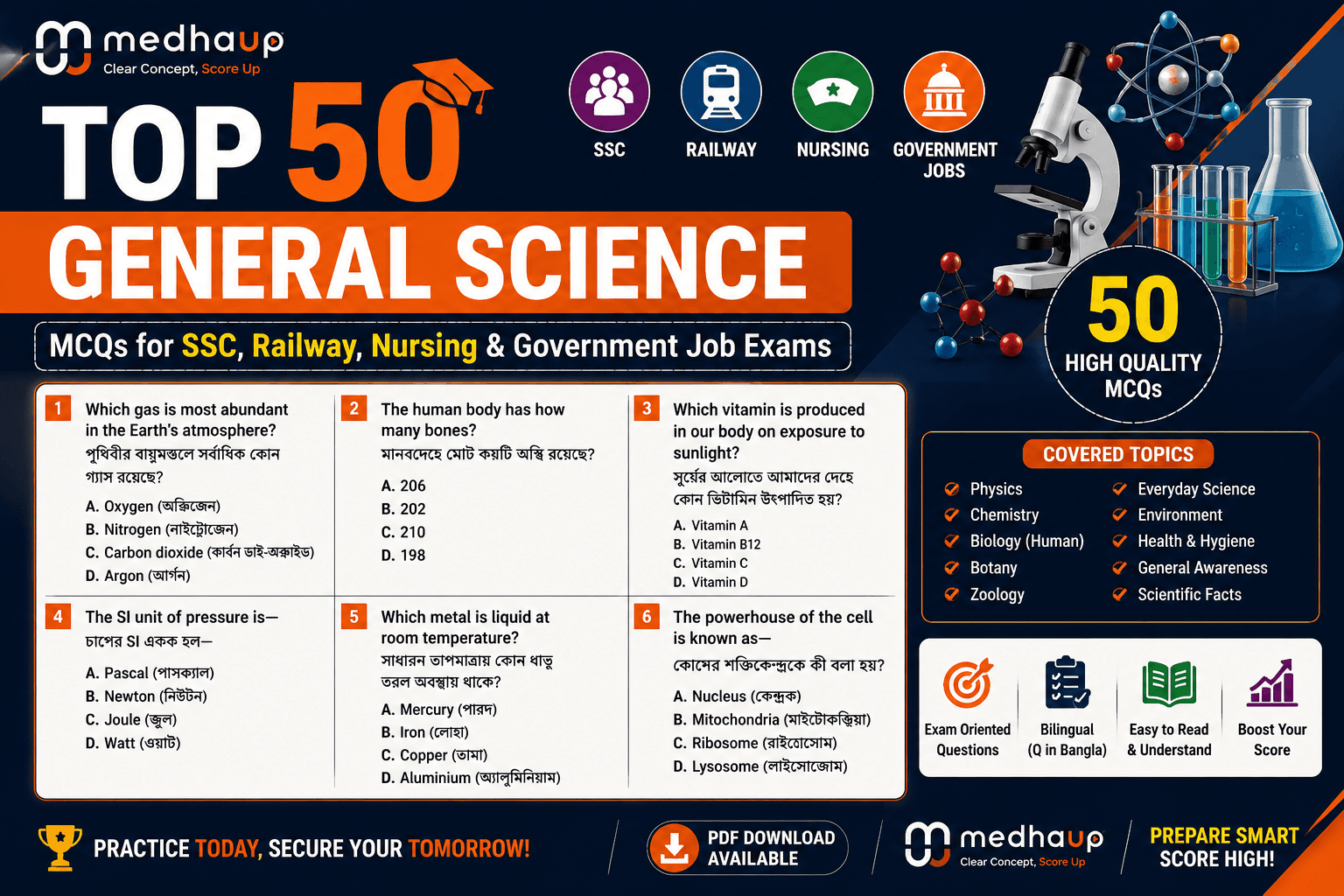
General Science is an important scoring area in many competitive examinations, including SSC, Railway, Nursing entrance and recruitment exams, State Government exams, Police exams, Group C/D recruitment, and other government job examinations.
Questions are usually asked from basic Biology, Physics, Chemistry, Human Physiology, Environment, Nutrition, Diseases, Everyday Science, and General Scientific Facts.
The best way to prepare is not only to memorise answers but also to understand the basic concept behind each question.
Below are 50 important General Science MCQs with answers and short explanations that are useful for competitive exam preparation.
Top 50 General Science MCQs
- Which organ mainly filters waste products from the blood?
A. Heart B. Kidney C. Liver D. Lungs
Correct Answer: B. Kidney
Explanation: Kidneys filter the blood and remove waste products and excess water to form urine.
- What is the functional unit of the kidney?
A. Neuron B. Nephron C. Alveolus D. Villus
Correct Answer: B. Nephron
Explanation: The nephron is the microscopic structural and functional unit responsible for filtration and urine formation.
- Which organelle is known as the powerhouse of the cell?
A. Ribosome B. Nucleus C. Mitochondrion D. Golgi apparatus
Correct Answer: C. Mitochondrion
Explanation: Mitochondria produce ATP, the main usable energy source of cells.
- Which blood cells help in fighting infections?
A. RBCs B. WBCs C. Platelets D. Plasma cells only
Correct Answer: B. WBCs
Explanation: White blood cells are an important part of the immune system and help protect the body against infections.
- Which component of blood helps in clotting?
A. Red blood cells B. Platelets C. Plasma only D. Haemoglobin
Correct Answer: B. Platelets
Explanation: Platelets participate in the blood-clotting process and help stop bleeding after injury.
- Haemoglobin contains which mineral?
A. Calcium B. Iron C. Sodium D. Potassium
Correct Answer: B. Iron
Explanation: Iron is an essential component of haemoglobin, which carries oxygen in the blood.
- Which blood group is commonly called the universal red-cell donor?
A. AB positive B. O negative C. A positive D. B negative
Correct Answer: B. O negative
Explanation: O-negative red blood cells lack A, B and Rh(D) antigens, so they are commonly used in emergencies when the recipient's blood type is unknown.
- Which blood group is commonly called the universal red-cell recipient?
A. AB positive B. O negative C. A negative D. B positive
Correct Answer: A. AB positive
Explanation: AB-positive individuals can generally receive red blood cells from all ABO and Rh blood groups.
- Which chamber of the human heart has the thickest muscular wall?
A. Right atrium B. Left atrium C. Right ventricle D. Left ventricle
Correct Answer: D. Left ventricle
Explanation: The left ventricle pumps oxygenated blood to the entire body and therefore needs a thick muscular wall.
- Which blood vessel carries oxygenated blood from the lungs to the heart?
A. Pulmonary artery B. Pulmonary vein C. Aorta D. Vena cava
Correct Answer: B. Pulmonary vein
Explanation: Pulmonary veins carry oxygen-rich blood from the lungs to the left atrium.
Biology and Human Physiology MCQs 11. The largest organ of the human body is:
A. Liver B. Brain C. Skin D. Lung
Correct Answer: C. Skin
Explanation: Skin is the body's largest organ by surface area and overall weight.
- The largest internal organ in the human body is:
A. Heart B. Liver C. Kidney D. Pancreas
Correct Answer: B. Liver
Explanation: The liver is the largest internal solid organ and performs many metabolic and detoxification functions.
- Which is the largest bone in the human body?
A. Humerus B. Tibia C. Femur D. Radius
Correct Answer: C. Femur
Explanation: The femur, or thigh bone, is the longest and strongest bone in the human body.
- Which is the smallest bone in the human body?
A. Stapes B. Radius C. Ulna D. Patella
Correct Answer: A. Stapes
Explanation: The stapes is a tiny bone located in the middle ear.
- Which part of the brain controls balance and coordination?
A. Cerebrum B. Cerebellum C. Medulla D. Hypothalamus
Correct Answer: B. Cerebellum
Explanation: The cerebellum coordinates voluntary movements, posture and balance.
- Which part of the brain controls breathing and heartbeat?
A. Cerebrum B. Cerebellum C. Medulla oblongata D. Frontal lobe
Correct Answer: C. Medulla oblongata
Explanation: The medulla controls several involuntary functions including respiration and heart rate.
- Which structure prevents food from entering the windpipe?
A. Uvula B. Epiglottis C. Trachea D. Larynx
Correct Answer: B. Epiglottis
Explanation: The epiglottis closes over the airway during swallowing.
- Gas exchange in the lungs mainly occurs in the:
A. Bronchi B. Trachea C. Alveoli D. Diaphragm
Correct Answer: C. Alveoli
Explanation: Alveoli are tiny air sacs surrounded by capillaries where oxygen and carbon dioxide are exchanged.
- Which organ secretes insulin?
A. Liver B. Pancreas C. Kidney D. Thyroid
Correct Answer: B. Pancreas
Explanation: Beta cells in the pancreatic islets produce insulin.
- Insulin mainly helps to:
A. Increase blood glucose B. Decrease blood glucose C. Increase blood pressure D. Increase body temperature
Correct Answer: B. Decrease blood glucose
Explanation: Insulin promotes glucose uptake and storage, helping lower blood glucose levels.
Vitamins, Nutrition and Diseases 21. Deficiency of Vitamin C causes:
A. Rickets B. Scurvy C. Beriberi D. Night blindness
Correct Answer: B. Scurvy
Explanation: Vitamin C deficiency causes scurvy, which can lead to bleeding gums and poor wound healing.
- Deficiency of Vitamin D causes:
A. Scurvy B. Rickets C. Beriberi D. Pellagra
Correct Answer: B. Rickets
Explanation: Vitamin D is required for calcium absorption and healthy bone development.
- Deficiency of Vitamin A may cause:
A. Night blindness B. Scurvy C. Anaemia D. Beriberi
Correct Answer: A. Night blindness
Explanation: Vitamin A is important for normal vision, especially in dim light.
- Deficiency of Vitamin B1 causes:
A. Beriberi B. Scurvy C. Rickets D. Goitre
Correct Answer: A. Beriberi
Explanation: Vitamin B1, or thiamine, is important for nerve and energy metabolism.
- Which mineral is essential for healthy bones and teeth?
A. Iron B. Calcium C. Iodine D. Sodium
Correct Answer: B. Calcium
Explanation: Calcium plays a major role in bone and tooth structure.
- Iodine deficiency commonly causes:
A. Goitre B. Rickets C. Scurvy D. Anaemia
Correct Answer: A. Goitre
Explanation: Iodine is required for thyroid hormone production. Deficiency can enlarge the thyroid gland.
- Iron deficiency commonly causes:
A. Anaemia B. Diabetes C. Goitre D. Hypertension
Correct Answer: A. Anaemia
Explanation: Iron deficiency can reduce haemoglobin production and cause iron-deficiency anaemia.
- Which vitamin is important for normal blood clotting?
A. Vitamin A B. Vitamin C C. Vitamin K D. Vitamin E
Correct Answer: C. Vitamin K
Explanation: Vitamin K is required for the synthesis of several clotting factors.
Plant Science MCQs 29. Photosynthesis mainly occurs in:
A. Mitochondria B. Chloroplasts C. Ribosomes D. Vacuoles
Correct Answer: B. Chloroplasts
Explanation: Chloroplasts contain chlorophyll and are the main site of photosynthesis in plant cells.
- The green pigment present in plants is:
A. Haemoglobin B. Chlorophyll C. Melanin D. Keratin
Correct Answer: B. Chlorophyll
Explanation: Chlorophyll absorbs light energy used during photosynthesis.
- Which gas is absorbed by plants during photosynthesis?
A. Oxygen B. Nitrogen C. Carbon dioxide D. Hydrogen
Correct Answer: C. Carbon dioxide
Explanation: Plants use carbon dioxide and water to produce glucose during photosynthesis.
- Which gas is mainly released during photosynthesis?
A. Carbon dioxide B. Oxygen C. Nitrogen D. Methane
Correct Answer: B. Oxygen
Explanation: Oxygen is released as a by-product of the light-dependent reactions of photosynthesis.
- Water and minerals are mainly absorbed by plants through:
A. Flowers B. Root hairs C. Fruits D. Stem bark
Correct Answer: B. Root hairs
Explanation: Root hairs increase the surface area available for absorption from soil.
Physics MCQs 34. What is the SI unit of force?
A. Joule B. Newton C. Watt D. Pascal
Correct Answer: B. Newton
Explanation: Force is measured in newtons (N).
- What is the SI unit of work?
A. Joule B. Watt C. Newton D. Ampere
Correct Answer: A. Joule
Explanation: Work and energy are measured in joules.
- What is the SI unit of power?
A. Joule B. Watt C. Newton D. Volt
Correct Answer: B. Watt
Explanation: Power is the rate at which work is done and is measured in watts.
- What is the SI unit of electric current?
A. Volt B. Ohm C. Ampere D. Watt
Correct Answer: C. Ampere
Explanation: Electric current is measured in amperes.
- Which instrument measures electric current?
A. Voltmeter B. Ammeter C. Barometer D. Hydrometer
Correct Answer: B. Ammeter
Explanation: An ammeter is connected in series to measure electric current.
- Which instrument measures atmospheric pressure?
A. Thermometer B. Barometer C. Hygrometer D. Ammeter
Correct Answer: B. Barometer
Explanation: A barometer measures atmospheric pressure.
- Sound cannot travel through:
A. Air B. Water C. Steel D. Vacuum
Correct Answer: D. Vacuum
Explanation: Sound requires a material medium for propagation.
- The pitch of a sound mainly depends on its:
A. Amplitude B. Frequency C. Speed D. Intensity
Correct Answer: B. Frequency
Explanation: Higher-frequency sounds are perceived as having a higher pitch.
- Loudness of sound mainly depends on:
A. Frequency B. Amplitude C. Wavelength only D. Speed only
Correct Answer: B. Amplitude
Explanation: Greater amplitude generally produces a louder sound.
- Which type of mirror is commonly used as a rear-view mirror in vehicles?
A. Plane mirror B. Concave mirror C. Convex mirror D. Cylindrical mirror
Correct Answer: C. Convex mirror
Explanation: A convex mirror provides a wider field of view and produces upright, diminished images.
- Which lens is used to correct myopia?
A. Convex lens B. Concave lens C. Cylindrical lens only D. Bifocal lens only
Correct Answer: B. Concave lens
Explanation: A concave lens diverges light and helps focus the image correctly on the retina in myopia.
Chemistry MCQs 45. What is the chemical formula of water?
A. CO₂ B. H₂O C. O₂ D. H₂O₂
Correct Answer: B. H₂O
Explanation: A water molecule contains two hydrogen atoms and one oxygen atom.
- Which gas turns lime water milky?
A. Oxygen B. Hydrogen C. Carbon dioxide D. Nitrogen
Correct Answer: C. Carbon dioxide
Explanation: Carbon dioxide reacts with calcium hydroxide to produce calcium carbonate, which makes lime water appear milky.
- Which acid is present in the human stomach?
A. Sulphuric acid B. Hydrochloric acid C. Nitric acid D. Acetic acid
Correct Answer: B. Hydrochloric acid
Explanation: Hydrochloric acid in gastric juice helps digestion and destroys many microorganisms.
- Which acid is present in vinegar?
A. Acetic acid B. Citric acid C. Hydrochloric acid D. Sulphuric acid
Correct Answer: A. Acetic acid
Explanation: Vinegar contains dilute acetic acid.
- A substance with pH less than 7 is generally:
A. Basic B. Neutral C. Acidic D. Metallic
Correct Answer: C. Acidic
Explanation: At ordinary conditions, a pH below 7 indicates acidity, while a pH above 7 indicates basicity.
- Rusting of iron requires:
A. Oxygen only B. Water only C. Oxygen and moisture D. Carbon dioxide only
Correct Answer: C. Oxygen and moisture
Explanation: Rusting is an oxidation process that normally requires both oxygen and water.
Quick Answer Key Q. Answer Q. Answer 1 B 26 A 2 B 27 A 3 C 28 C 4 B 29 B 5 B 30 B 6 B 31 C 7 B 32 B 8 A 33 B 9 D 34 B 10 B 35 A 11 C 36 B 12 B 37 C 13 C 38 B 14 A 39 B 15 B 40 D 16 C 41 B 17 B 42 B 18 C 43 C 19 B 44 B 20 B 45 B 21 B 46 C 22 B 47 B 23 A 48 A 24 A 49 C 25 B 50 C Topic-Wise Distribution of These 50 Questions
These MCQs cover the major General Science areas frequently useful for competitive exams:
Biology & Human Physiology
Questions on blood, heart, kidney, brain, lungs, hormones and organs.
Nutrition & Diseases
Questions on vitamins, minerals, deficiency diseases and basic nutrition.
Botany
Questions on photosynthesis, chlorophyll and plant absorption.
Physics
Questions on force, power, current, sound, optics and measuring instruments.
Chemistry
Questions on acids, pH, water, carbon dioxide and oxidation.
How to Prepare General Science for Competitive Exams
General Science is often easier to score in than highly calculation-based sections if candidates build strong basic concepts.
A practical preparation strategy is:
- Build Class 6–10 Science Fundamentals
Most SSC, Railway and general government-job science questions are based on fundamental school-level science.
Focus on:
Human body Nutrition Diseases Plants Motion and force Heat Light Sound Electricity Acids, bases and salts Metals and non-metals Everyday chemistry. 2. Study Biology Regularly
Biology questions are particularly important in exams connected with:
Nursing Health recruitment General Science Railway exams State-level recruitment.
Important areas include:
Blood Heart Digestive system Respiratory system Nervous system Endocrine system Vitamins Diseases Reproduction Genetics Plant physiology. 3. Learn Science Through MCQs
Instead of reading the same chapter repeatedly, solve questions immediately after learning a concept.
For example:
Concept: Vitamin C deficiency causes scurvy.
Then practise related questions:
Which vitamin prevents scurvy? Which vitamin helps collagen formation? Which disease is caused by Vitamin C deficiency?
This helps convert information into exam-ready knowledge.
- Revise Wrong Answers
Create a separate notebook or digital note called:
“Science Mistakes”
Whenever you answer incorrectly, write:
Question → Correct Answer → One-line Concept
Revision of mistakes is usually more useful than repeatedly solving questions you already know.
- Practise Mixed Science Tests
Do not prepare Biology, Physics and Chemistry only in isolation.
Competitive exams normally mix all three.
A good revision cycle can be:
20 Biology MCQs + 15 Physics MCQs + 15 Chemistry MCQs
This simulates a mixed General Science section.
Important General Science Topics for SSC Exams
SSC aspirants should focus especially on:
Human body systems Vitamins and deficiency diseases Diseases and pathogens SI units Motion and force Work, energy and power Heat and temperature Sound Light Electricity Acids, bases and salts Metals Periodic-table basics Everyday science. Important Science Topics for Railway Exams
For Railway examinations such as RRB Group D and other applicable RRB recruitments, candidates should pay particular attention to school-level:
Physics
Motion, force, work, energy, electricity, magnetism, heat, light and sound.
Chemistry
Atoms, molecules, acids, bases, salts, metals, non-metals and everyday chemical reactions.
Biology
Human body, nutrition, diseases, environment, plants and basic life science.
Important Science Topics for Nursing Exams
Nursing entrance and recruitment examinations generally require stronger Biology and Human Physiology preparation.
High-priority areas include:
Anatomy and physiology Blood Heart Respiratory system Kidney Nervous system Hormones Vitamins Nutrition Communicable diseases Immunity Microbiology basics.
Candidates preparing for ANM, GNM or other nursing-related exams should give these areas additional revision.
Frequently Asked Questions Are these MCQs useful for SSC exams?
Yes. These questions cover basic General Science concepts commonly relevant to SSC-level preparation, including Biology, Physics and Chemistry.
Are these questions useful for Railway exams?
Yes. The set includes school-level General Science concepts that are useful for RRB and other Railway recruitment preparation.
Are these MCQs useful for ANM/GNM and Nursing exams?
Yes. A substantial portion of the set covers Human Biology, physiology, vitamins and health-related science, which are particularly useful for nursing entrance and recruitment exams.
Which science subject is most important?
It depends on the examination.
For nursing exams, Biology/Human Physiology usually deserves extra attention.
For broad SSC and Railway preparation, candidates should maintain a balanced preparation across Physics, Chemistry and Biology.
How many General Science MCQs should I practise daily?
A practical target is around 30–50 quality MCQs daily, followed by revision of incorrect answers.
Quality of review is more important than solving hundreds of questions without understanding mistakes.
Should I memorise only answers?
No.
Try to learn at least one basic concept behind every answer.
For example:
Question: Sound cannot travel through what? Answer: Vacuum.
Do not stop there. Remember the concept:
Sound is a mechanical wave and requires a material medium.
That single concept can solve several related questions.
Final Words
General Science can become a highly scoring area in SSC, Railway, Nursing and Government Job examinations if candidates focus on basic concepts and regular MCQ practice.
The 50 questions above cover important topics from:
Biology Human Physiology Vitamins & Nutrition Botany Physics Chemistry Everyday Science
Do not just read the answers once.
A better method is:
Attempt → Check Answer → Read Explanation → Mark Mistakes → Revise Again
Regular practice with this approach can improve both accuracy and confidence in General Science sections.
SEO Details
SEO Title: Top 50 General Science MCQs for SSC, Railway, Nursing & Government Job Exams
Meta Description: Practice 50 important General Science MCQs with answers and explanations for SSC, Railway, Nursing, ANM/GNM and government job exams. Covers Biology, Physics, Chemistry, vitamins, human body and everyday science.
Suggested URL Slug: top-50-general-science-mcqs-ssc-railway-nursing-government-exams
Focus Keyword: General Science MCQs
Secondary Keywords: General Science Questions with Answers, SSC Science MCQs, Railway Science MCQs, Nursing Science MCQs, Government Exam Science Questions
Related Keywords: General Science MCQ for competitive exams, Biology MCQ, Physics MCQ, Chemistry MCQ, ANM GNM Science Questions, RRB Science Questions, SSC General Science Questions, Nursing Entrance MCQ
Suggested Featured Image Text:
TOP 50 GENERAL SCIENCE MCQs 🔥 SSC • RAILWAY • NURSING GOVT JOB EXAMS WITH ANSWERS
Alternative Featured Image Text:
GENERAL SCIENCE 🔬 50 MUST-DO MCQs SSC | RRB | NURSING | GOVT EXAMS
Have a question about your preparation?
Message us on WhatsApp — Bengali or English, we reply the same day.
Chat on WhatsApp