Top 50 Biology MCQs for ANM/GNM, JENPAS-UG and Nursing Entrance Exams
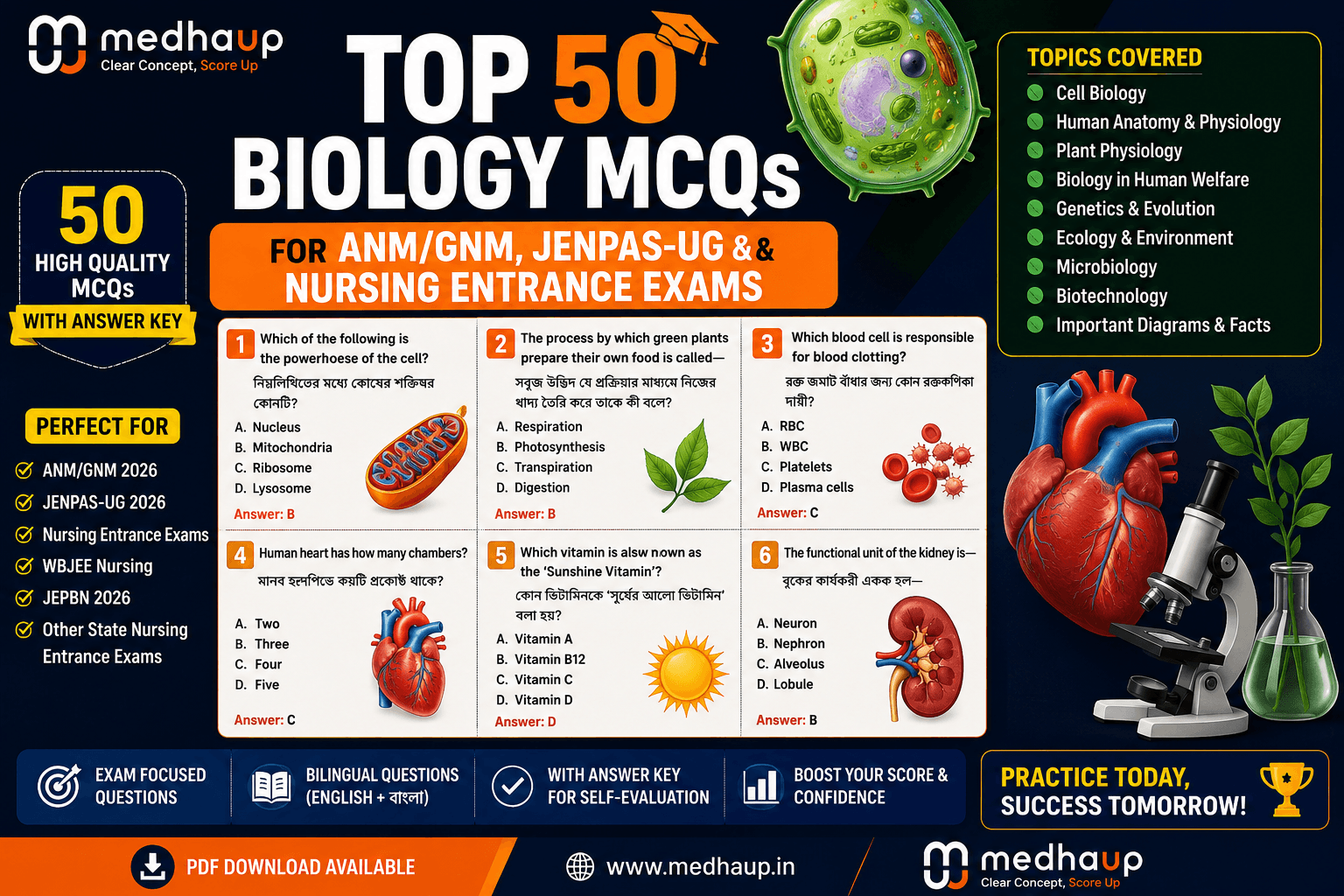
Biology is one of the most important scoring subjects for ANM/GNM, JENPAS-UG and other nursing entrance examinations. Questions are commonly asked from Human Anatomy, Physiology, Cell Biology, Genetics, Nutrition, Diseases, Reproduction, Plant Biology and basic Microbiology.
For nursing aspirants, Human Biology deserves particular attention because topics such as the heart, blood, kidney, respiratory system, nervous system, hormones, digestion, vitamins and diseases are repeatedly tested.
Below are 50 important Biology MCQs with answers and short explanations for nursing entrance preparation.
Top 50 Biology MCQs
- What is the structural and functional unit of life?
A. Tissue B. Cell C. Organ D. Nucleus
Correct Answer: B. Cell
Explanation: The cell is considered the basic structural and functional unit of all living organisms.
- Which organelle is known as the powerhouse of the cell?
A. Ribosome B. Golgi apparatus C. Mitochondrion D. Lysosome
Correct Answer: C. Mitochondrion
Explanation: Mitochondria produce ATP through cellular respiration and supply energy to the cell.
- Which organelle is mainly responsible for protein synthesis?
A. Ribosome B. Lysosome C. Vacuole D. Centriole
Correct Answer: A. Ribosome
Explanation: Ribosomes translate genetic information into proteins.
- The control centre of a eukaryotic cell is:
A. Cytoplasm B. Nucleus C. Cell membrane D. Mitochondrion
Correct Answer: B. Nucleus
Explanation: The nucleus contains DNA and regulates many cellular activities.
- Which organelle contains digestive enzymes that break down cellular waste?
A. Ribosome B. Lysosome C. Nucleolus D. Centrosome
Correct Answer: B. Lysosome
Explanation: Lysosomes contain hydrolytic enzymes that digest damaged organelles and cellular waste.
Human Blood and Circulation 6. Which blood cells carry oxygen?
A. WBCs B. RBCs C. Platelets D. Lymphocytes
Correct Answer: B. RBCs
Explanation: Red blood cells contain haemoglobin, which binds and transports oxygen.
- Haemoglobin contains which mineral?
A. Calcium B. Iron C. Sodium D. Iodine
Correct Answer: B. Iron
Explanation: Iron forms an important part of the haem group of haemoglobin.
- Which blood component mainly helps in clotting?
A. Plasma B. Platelets C. RBCs D. Neutrophils
Correct Answer: B. Platelets
Explanation: Platelets form the initial platelet plug and help initiate blood clotting.
- Which blood cells protect the body against infection?
A. RBCs B. WBCs C. Platelets D. Erythrocytes
Correct Answer: B. WBCs
Explanation: White blood cells are important components of the immune system.
- Which chamber of the heart has the thickest muscular wall?
A. Right atrium B. Left atrium C. Right ventricle D. Left ventricle
Correct Answer: D. Left ventricle
Explanation: The left ventricle pumps blood throughout the systemic circulation and therefore requires the strongest muscular wall.
- Which blood vessel carries oxygenated blood from the lungs to the heart?
A. Pulmonary artery B. Pulmonary vein C. Aorta D. Vena cava
Correct Answer: B. Pulmonary vein
Explanation: Pulmonary veins return oxygenated blood from the lungs to the left atrium.
- Which artery carries deoxygenated blood?
A. Aorta B. Renal artery C. Pulmonary artery D. Coronary artery
Correct Answer: C. Pulmonary artery
Explanation: The pulmonary artery carries deoxygenated blood from the right ventricle to the lungs.
- The natural pacemaker of the human heart is:
A. AV node B. SA node C. Purkinje fibres D. Bundle of His
Correct Answer: B. SA node
Explanation: The sinoatrial node normally initiates the electrical impulses that regulate heart rhythm.
Respiratory System 14. Gas exchange in the lungs takes place mainly in:
A. Bronchi B. Trachea C. Alveoli D. Larynx
Correct Answer: C. Alveoli
Explanation: Alveoli provide a large, thin surface for exchange of oxygen and carbon dioxide.
- Which structure prevents food from entering the windpipe?
A. Uvula B. Epiglottis C. Bronchus D. Diaphragm
Correct Answer: B. Epiglottis
Explanation: During swallowing, the epiglottis helps cover the opening of the airway.
- Which muscle plays a major role in normal breathing?
A. Biceps B. Diaphragm C. Triceps D. Deltoid
Correct Answer: B. Diaphragm
Explanation: Contraction of the diaphragm increases thoracic volume and helps draw air into the lungs.
Digestive System 17. Digestion of starch begins in the:
A. Stomach B. Mouth C. Small intestine D. Large intestine
Correct Answer: B. Mouth
Explanation: Salivary amylase starts the digestion of starch in the oral cavity.
- Which enzyme is present in saliva?
A. Pepsin B. Trypsin C. Salivary amylase D. Lipase only
Correct Answer: C. Salivary amylase
Explanation: Salivary amylase begins carbohydrate digestion.
- Hydrochloric acid is secreted in the:
A. Mouth B. Stomach C. Pancreas D. Large intestine
Correct Answer: B. Stomach
Explanation: Gastric glands secrete hydrochloric acid, which creates an acidic environment for digestion.
- Most absorption of digested nutrients occurs in the:
A. Oesophagus B. Stomach C. Small intestine D. Large intestine
Correct Answer: C. Small intestine
Explanation: Villi and microvilli in the small intestine greatly increase the surface area for nutrient absorption.
- Bile is produced by the:
A. Pancreas B. Liver C. Gall bladder D. Stomach
Correct Answer: B. Liver
Explanation: The liver produces bile, which is stored and concentrated in the gall bladder.
- The main role of bile in digestion is to help:
A. Digest proteins directly B. Emulsify fats C. Digest starch D. Absorb oxygen
Correct Answer: B. Emulsify fats
Explanation: Bile breaks large fat globules into smaller droplets, increasing the surface area for lipase action.
Excretory System 23. Which organs mainly remove nitrogenous waste from the blood?
A. Lungs B. Kidneys C. Heart D. Stomach
Correct Answer: B. Kidneys
Explanation: Kidneys filter the blood and remove wastes in the form of urine.
- What is the functional unit of the kidney?
A. Neuron B. Nephron C. Alveolus D. Villus
Correct Answer: B. Nephron
Explanation: Each nephron performs filtration, reabsorption and secretion during urine formation.
- Filtration of blood in a nephron begins mainly in the:
A. Loop of Henle B. Glomerulus C. Collecting duct D. Ureter
Correct Answer: B. Glomerulus
Explanation: Blood pressure forces water and small solutes from glomerular capillaries into Bowman's capsule.
Nervous System and Sense Organs 26. The structural and functional unit of the nervous system is:
A. Nephron B. Neuron C. Osteon D. Alveolus
Correct Answer: B. Neuron
Explanation: Neurons receive and transmit nerve impulses.
- Which part of the brain controls balance and coordination?
A. Cerebrum B. Cerebellum C. Medulla D. Hypothalamus
Correct Answer: B. Cerebellum
Explanation: The cerebellum coordinates movement, posture and balance.
- Which part of the brain controls many involuntary activities such as breathing and heart rate?
A. Cerebrum B. Medulla oblongata C. Cerebellum D. Corpus callosum
Correct Answer: B. Medulla oblongata
Explanation: The medulla contains centres that regulate vital involuntary functions.
- Which part of the eye controls the amount of light entering?
A. Retina B. Iris C. Cornea D. Optic nerve
Correct Answer: B. Iris
Explanation: The iris changes pupil size and thereby regulates the amount of incoming light.
- The image in the human eye is formed on the:
A. Cornea B. Iris C. Retina D. Sclera
Correct Answer: C. Retina
Explanation: The eye lens focuses light onto the retina, where photoreceptors detect it.
Endocrine System and Hormones 31. Which hormone lowers blood glucose level?
A. Adrenaline B. Insulin C. Thyroxine D. Glucagon
Correct Answer: B. Insulin
Explanation: Insulin promotes glucose uptake and storage, thereby lowering blood glucose.
- Which hormone increases blood glucose during emergencies?
A. Insulin B. Adrenaline C. Estrogen D. Prolactin
Correct Answer: B. Adrenaline
Explanation: Adrenaline helps mobilise stored energy during the fight-or-flight response.
- Thyroxine is secreted by which gland?
A. Pituitary B. Thyroid C. Pancreas D. Adrenal
Correct Answer: B. Thyroid
Explanation: Thyroxine helps regulate metabolism and growth.
- Which gland is commonly called the master gland?
A. Thyroid B. Pituitary C. Adrenal D. Pancreas
Correct Answer: B. Pituitary
Explanation: The pituitary releases hormones that regulate several other endocrine glands.
Vitamins, Nutrition and Deficiency Diseases 35. Deficiency of Vitamin A can cause:
A. Scurvy B. Night blindness C. Beriberi D. Rickets
Correct Answer: B. Night blindness
Explanation: Vitamin A is necessary for normal visual pigment formation and vision in dim light.
- Vitamin B1 deficiency causes:
A. Beriberi B. Scurvy C. Goitre D. Rickets
Correct Answer: A. Beriberi
Explanation: Vitamin B1, or thiamine, is important for carbohydrate metabolism and normal nerve function.
- Vitamin C deficiency causes:
A. Beriberi B. Scurvy C. Pellagra D. Rickets
Correct Answer: B. Scurvy
Explanation: Vitamin C deficiency may lead to bleeding gums, poor wound healing and connective-tissue problems.
- Vitamin D deficiency in children causes:
A. Rickets B. Goitre C. Anaemia D. Scurvy
Correct Answer: A. Rickets
Explanation: Vitamin D is important for calcium absorption and normal bone mineralisation.
- Which vitamin is essential for normal blood clotting?
A. Vitamin A B. Vitamin K C. Vitamin C D. Vitamin D
Correct Answer: B. Vitamin K
Explanation: Vitamin K is needed for the production of several clotting factors.
- Iodine deficiency can cause:
A. Goitre B. Anaemia C. Rickets D. Scurvy
Correct Answer: A. Goitre
Explanation: Iodine is needed to produce thyroid hormones. Deficiency can enlarge the thyroid gland.
Reproductive Biology and Genetics 41. Fertilisation in humans usually occurs in the:
A. Uterus B. Fallopian tube C. Ovary D. Vagina
Correct Answer: B. Fallopian tube
Explanation: Fertilisation normally occurs in the ampullary region of the fallopian tube.
- The male reproductive cell is called:
A. Ovum B. Sperm C. Zygote D. Embryo
Correct Answer: B. Sperm
Explanation: Sperm is the male gamete.
- The female reproductive cell is called:
A. Sperm B. Ovum C. Zygote D. Placenta
Correct Answer: B. Ovum
Explanation: The ovum or egg cell is the female gamete.
- The fusion of male and female gametes forms a:
A. Placenta B. Zygote C. Foetus D. Ovary
Correct Answer: B. Zygote
Explanation: Fertilisation produces a diploid zygote.
- The basic unit of heredity is:
A. Cell B. Gene C. Tissue D. Ribosome
Correct Answer: B. Gene
Explanation: Genes are DNA sequences that carry hereditary information.
- DNA stands for:
A. Deoxyribonucleic Acid B. Double Nitrogen Acid C. Deoxygenated Nuclear Acid D. Dynamic Nucleic Acid
Correct Answer: A. Deoxyribonucleic Acid
Explanation: DNA stores most of the hereditary information in cells.
Plant Biology and Microbiology 47. Photosynthesis mainly occurs in:
A. Mitochondria B. Chloroplasts C. Ribosomes D. Nucleus
Correct Answer: B. Chloroplasts
Explanation: Chloroplasts contain chlorophyll and are the major site of photosynthesis in plant cells.
- Which pigment gives green plants their characteristic colour?
A. Melanin B. Chlorophyll C. Haemoglobin D. Keratin
Correct Answer: B. Chlorophyll
Explanation: Chlorophyll absorbs light energy for photosynthesis and reflects green wavelengths.
- Which structures mainly absorb water and minerals from the soil?
A. Leaves B. Root hairs C. Flowers D. Fruits
Correct Answer: B. Root hairs
Explanation: Root hairs provide a large surface area for absorption of water and mineral ions.
- Which microorganism causes tuberculosis?
A. Vibrio cholerae B. Mycobacterium tuberculosis C. Plasmodium D. Salmonella Typhi
Correct Answer: B. Mycobacterium tuberculosis
Explanation: Tuberculosis is caused by the bacterium Mycobacterium tuberculosis.
Quick Answer Key Q. Ans. Q. Ans. 1 B 26 B 2 C 27 B 3 A 28 B 4 B 29 B 5 B 30 C 6 B 31 B 7 B 32 B 8 B 33 B 9 B 34 B 10 D 35 B 11 B 36 A 12 C 37 B 13 B 38 A 14 C 39 B 15 B 40 A 16 B 41 B 17 B 42 B 18 C 43 B 19 B 44 B 20 C 45 B 21 B 46 A 22 B 47 B 23 B 48 B 24 B 49 B 25 B 50 B Topic-Wise Distribution
These 50 MCQs cover some of the highest-value Biology topics for nursing entrance exams.
Cell Biology
Questions 1–5
Blood and Circulation
Questions 6–13
Respiratory System
Questions 14–16
Digestive System
Questions 17–22
Excretory System
Questions 23–25
Nervous System and Sense Organs
Questions 26–30
Endocrine System
Questions 31–34
Vitamins and Nutrition
Questions 35–40
Reproduction and Genetics
Questions 41–46
Plant Biology and Microbiology
Questions 47–50
Most Important Biology Topics for ANM/GNM
ANM/GNM aspirants should give special attention to:
Cell and cell organelles Human blood Heart and circulation Respiratory system Digestive system Excretory system Nervous system Endocrine glands Vitamins and deficiency diseases Nutrition Human reproduction Communicable diseases Immunity Plant physiology.
Human Physiology should be revised repeatedly because many entrance questions are based on basic organ functions.
Important Biology Topics for JENPAS-UG
JENPAS-UG aspirants should develop a broader Biology base, especially in:
Cell Biology Biomolecules Human Physiology Genetics Reproduction Plant Physiology Ecology Evolution Biotechnology Microbiology Health and disease.
Candidates should study according to the syllabus prescribed for their applicable examination cycle and use MCQ practice to identify weak chapters.
Why Biology Is Important for Nursing Entrance Exams
Nursing is fundamentally linked to human health and physiology.
Understanding Biology helps students later understand subjects such as:
Anatomy Physiology Pathology Microbiology Pharmacology Nutrition Medical-Surgical Nursing.
For entrance exams, this makes basic Biology not only a scoring section but also useful preparation for future nursing studies.
How to Prepare Biology for ANM/GNM and JENPAS-UG
- Understand the Concept Before Memorising
For example:
Instead of memorising only:
Nephron = Functional unit of kidney
also understand:
Glomerulus → filtration Renal tubule → reabsorption and secretion Collecting duct → final urine concentration
One concept can then solve multiple MCQs.
- Make One-Line Revision Notes
Convert chapters into quick-revision facts.
Examples:
SA Node → Natural pacemaker of heart
Alveoli → Site of pulmonary gas exchange
Insulin → Lowers blood glucose
Cerebellum → Balance and coordination
Vitamin C deficiency → Scurvy
This method is extremely useful before mock tests.
- Practise 30–50 MCQs Every Day
A practical Biology routine can include:
20 Human Physiology MCQs 10 Cell/Genetics MCQs 10 Plant Biology MCQs 10 Disease/Nutrition MCQs
Then review every wrong answer.
- Maintain a “Wrong Answer Notebook”
Do not just check the correct answer and move on.
Write:
Question Your wrong answer Correct answer One-line reason
For example:
Wrong: Pulmonary artery carries oxygenated blood Correct: Pulmonary artery carries deoxygenated blood from the right ventricle to the lungs.
Repeated revision of mistakes dramatically improves accuracy.
- Use Diagrams for Anatomy
Human Biology is much easier when studied visually.
Practise labelled diagrams of:
Heart Kidney and nephron Human digestive system Respiratory system Brain Eye Male reproductive system Female reproductive system Plant cell Animal cell.
Entrance questions may ask functions even when they do not directly show a diagram.
- Focus on “Difference Between” Topics
Many Biology MCQs come from confusing pairs.
Examples:
Artery vs Vein RBC vs WBC Insulin vs Glucagon Cerebrum vs Cerebellum Mitosis vs Meiosis Xylem vs Phloem Vitamin A vs Vitamin D deficiency Pulmonary artery vs Pulmonary vein
Create comparison tables for these topics.
- Revise Vitamins and Diseases Regularly
These are easy marks if memorised correctly.
Nutrient Deficiency/Association Vitamin A Night blindness Vitamin B1 Beriberi Vitamin C Scurvy Vitamin D Rickets Vitamin K Clotting function Iron Iron-deficiency anaemia Iodine Goitre
These one-line facts are frequently useful in nursing and general-science MCQs.
- Practise Human Physiology More Than Once
Do not study the heart or kidney once and consider it finished.
A better revision cycle is:
Day 1 — Learn Day 3 — MCQ practice Day 7 — Revise Day 15 — Mixed test
This spaced-revision pattern helps retain information for longer.
15 High-Priority One-Line Biology Facts Cell is the basic unit of life. Mitochondria produce ATP. Ribosomes synthesize proteins. RBCs carry oxygen. Platelets help in clotting. SA node is the natural pacemaker. Alveoli are the main site of gas exchange. Small intestine absorbs most nutrients. Nephron is the functional unit of kidney. Cerebellum controls balance and coordination. Insulin lowers blood glucose. Vitamin C deficiency causes scurvy. Fertilisation usually occurs in the fallopian tube. Gene is the basic unit of heredity. Chloroplast is the main site of photosynthesis. Common Mistakes Biology Students Make
- Memorising without understanding
This creates confusion when the same concept is asked differently.
- Ignoring Human Physiology
For nursing-related exams, this can cost many marks.
- Studying only questions without reading concepts
MCQs should be used to test knowledge, not completely replace theory.
- Never revising wrong answers
Repeated mistakes usually come from concepts that were never properly corrected.
- Confusing similar organs and hormones
Make comparison charts.
- Ignoring basic Class 9–12 Biology concepts
Many entrance questions are built from fundamental school-level science.
Frequently Asked Questions Are these MCQs useful for ANM/GNM entrance exams?
Yes. The set contains high-value Human Biology, physiology, nutrition, reproduction and disease-related concepts useful for ANM/GNM preparation.
Are these questions useful for JENPAS-UG?
Yes. They are useful for fundamental revision, although JENPAS-UG candidates should also prepare the full Biology syllabus prescribed for their examination.
Are these MCQs useful for nursing entrance exams?
Yes. Human Anatomy, Physiology, Nutrition, Reproduction and basic Microbiology are especially relevant for nursing entrance preparation.
Which Biology chapter is most important for nursing exams?
Human Physiology is one of the most important broad areas.
Focus especially on:
Blood Heart Respiration Digestion Kidney Nervous system Hormones Reproduction. How many Biology MCQs should I solve daily?
A practical target is around 30–50 high-quality MCQs daily, followed by careful review of mistakes.
Should I learn answers only?
No.
For every MCQ, remember at least one concept or reason behind the answer.
For example:
Question: Which chamber has the thickest wall? Answer: Left ventricle.
Concept:
The left ventricle must generate high pressure to pump blood through systemic circulation.
That concept can solve several related questions.
Final Words
Biology can become one of the highest-scoring areas in ANM/GNM, JENPAS-UG and nursing entrance examinations when candidates combine concept learning with regular MCQ practice.
The 50 questions above cover:
Cell Biology Blood and Heart Respiration Digestion Kidney Nervous System Hormones Vitamins Reproduction Genetics Plant Biology Microbiology
For better preparation, use the following pattern:
Learn → Solve MCQs → Analyse Mistakes → Revise → Take Mixed Tests
Do not focus only on how many questions you solve.
Focus on how many concepts you can remember and apply correctly in the exam.
SEO Details
SEO Title: Top 50 Biology MCQs for ANM/GNM, JENPAS-UG & Nursing Entrance Exams
Meta Description: Practice 50 important Biology MCQs with answers and explanations for ANM/GNM, JENPAS-UG and Nursing entrance exams. Covers human physiology, cells, blood, hormones, vitamins, reproduction, genetics and more.
Suggested URL Slug: top-50-biology-mcqs-anm-gnm-jenpas-ug-nursing-exams
Focus Keyword: Biology MCQs for ANM GNM
Secondary Keywords: ANM GNM Biology Questions, JENPAS UG Biology MCQ, Nursing Entrance Biology Questions, Biology MCQ with Answers, Human Physiology MCQ
Related Keywords: ANM GNM Biology MCQ 2026, JENPAS UG Biology questions, Nursing entrance MCQ, Human Body MCQ, Biology competitive exam questions, Anatomy Physiology MCQ, Nursing Biology practice questions
Suggested Featured Image Text:
TOP 50 BIOLOGY MCQs 🧬 ANM/GNM • JENPAS-UG NURSING ENTRANCE WITH ANSWERS
Alternative Featured Image Text:
BIOLOGY 🔥 50 MUST-DO MCQs ANM/GNM | JENPAS | NURSING
Have a question about your preparation?
Message us on WhatsApp — Bengali or English, we reply the same day.
Chat on WhatsApp