ANM/GNM 2026 Choice Locking Mistakes That Can Cost You a Government Nursing Seat
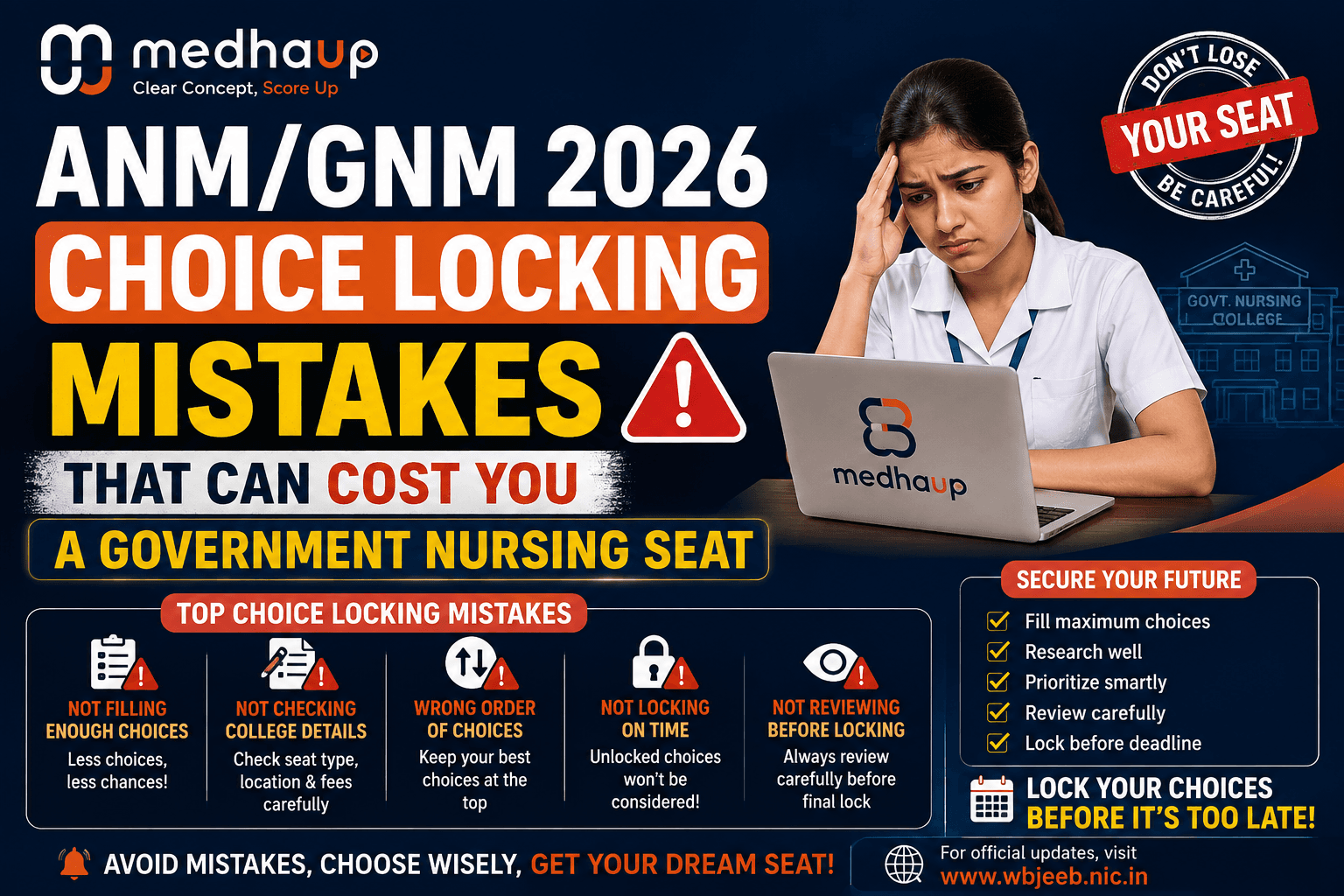
For thousands of ANM/GNM aspirants, getting a good rank is only half the battle. The other half is filling and locking college choices correctly during counselling.
A candidate may have a rank good enough for a government nursing college and still miss that opportunity because of a badly arranged preference list, too few choices, incorrect category information, or misunderstanding of the upgradation rules.
This is particularly important today because the ANM(R) & GNM 2026 Round 1 registration, choice filling, modification and choice locking window runs from 14 August to 17 August 2026. The Round 1 seat allotment result is scheduled for 19 August 2026.
WBJEEB has clearly stated that seat allotment depends not only on rank but also on eligibility, reservation status, availability of seats and, importantly, the order of choices submitted and locked by the candidate.
So before clicking the final lock button, understand these mistakes carefully.
Why Is Choice Order So Important in ANM/GNM Counselling?
During ANM/GNM counselling, candidates select eligible institutes and arrange them according to their own priority. WBJEEB states that the order of submitted and locked choices is one of the factors used for allotment.
In simple terms:
Choice No. 1 should be the college you would most like to join.
Choice No. 2 should be your next preference, Choice No. 3 your next preference, and so on.
Do not arrange colleges merely according to expected closing rank or because somebody told you that a particular college is a "safe option."
Your choice list should represent your actual admission preference.
Mistake 1: Putting a Private College Above a Government College You Actually Prefer
This can be one of the most expensive mistakes.
Suppose your list looks like this:
Preference College Choice 1 Private Nursing College A Choice 2 Government Nursing College B Choice 3 Government Nursing College C Choice 4 Private Nursing College D
But in reality, you would prefer Government College B over Private College A.
Then your preference order does not represent what you actually want.
Since the order of locked choices is considered during allotment, candidates should place colleges in their genuine order of preference, not according to guesses about where a seat might be easier to obtain.
Better Strategy
If you prefer government colleges, arrange your preferred government institutes above private colleges.
A private college should be placed above a government college only when you would genuinely choose that private institution over the government option.
Mistake 2: Thinking “Safe College Must Be Choice No. 1”
Many candidates hear statements such as:
“Your rank is borderline, so put the safest college first.”
This can be misleading.
Your first preference should not automatically be the college where you believe your rank has the highest chance of getting a seat.
It should normally be the best college among the options that you genuinely want to join.
WBJEEB considers merit rank, eligibility, reservation, vacancies and the candidate's locked preference order while making allotments.
Therefore, your list can contain a combination of:
Dream choices → Strong preferences → Realistic choices → Safer choices → Backup options
The important point is that all of them should remain in the order in which you would actually prefer admission.
Mistake 3: Filling Only 5–10 Colleges
This is one of the easiest mistakes to avoid.
WBJEEB specifically advises candidates to select the maximum possible number of suitable institutes/branches because doing so increases the chance of allotment. The Board further advises candidates to enter at least 20 choices.
If 30 or 40 acceptable colleges are available to you but you select only five, you have voluntarily removed yourself from consideration for the remaining options.
A candidate with a comparatively weaker rank but a broader and properly arranged choice list may therefore have more possible allotment opportunities than someone who selected only a handful of colleges.
Remember
More acceptable choices = more possible allotment opportunities.
But do not add a college merely to increase the number if you are absolutely unwilling to study there.
Mistake 4: Putting a College in Your List That You Would Never Join
This is especially dangerous if you place such a college at the top.
WBJEEB's 2026 counselling rules state that if a candidate is allotted their first choice, the candidate must complete document verification and take admission within the stipulated time. Failure to do so leads to the candidate being debarred from the entire counselling procedure and from further rounds.
Therefore, never make something your Choice No. 1 simply because:
“Everyone says it is good.”
“My friend put it first.”
“I thought I wouldn't get it anyway.”
“I just wanted to see whether I could get it.”
If you place a college at No. 1, be prepared for the possibility that you may actually be allotted that college.
Mistake 5: Copying Someone Else's Choice List
There is no universal “best ANM/GNM choice list” for every candidate.
A good preference list depends on several personal factors: rank, category, gender eligibility, preferred course, distance from home, hostel requirements, government/private preference, affordability, location and the colleges the candidate would actually be willing to attend.
WBJEEB also displays only those institutes/courses available according to the candidate's eligibility based on the information entered during registration.
Therefore, blindly copying a friend's, teacher's, Telegram group's or YouTube video's preference list can create a list that does not match your own situation.
Use recommendations for research, but make the final preference order personal.
Mistake 6: Confusing Alphabetical Order With Preference Order
This is an easy technical mistake.
WBJEEB states that available choices may initially be shown in alphabetical order to make searching easier. Candidates must then arrange selected institutes/courses according to their own priority.
Alphabetical order is not a recommended ranking of colleges.
For example, a college appearing at the top merely because its name begins with “A” does not mean it should become Choice No. 1.
Always manually check your final preference numbers before locking.
Mistake 7: Leaving Out Government Colleges Because Last Year's Closing Rank Was Better Than Your Rank
Previous-year closing ranks are useful for estimating your chances, but they should not automatically become hard cut-offs for your choice list.
A closing rank can change from year to year depending on seat availability, candidate preferences, category distribution, participation and vacancies.
The 2026 counselling rules make it clear that allotments depend on current-year merit rank, eligibility, reservation status, vacancies and locked choices.
Therefore, if a government college is genuinely desirable and available to you in the counselling portal, it can be reasonable to include it in its proper preference position instead of removing it merely because last year's closing rank looked difficult.
After the ambitious preferences, include enough realistic and backup choices.
Mistake 8: Filling Only “Dream Government Colleges”
The opposite mistake is equally risky.
Imagine a candidate enters only five highly demanded government colleges and leaves every other acceptable government institution out of the list.
If their rank is insufficient for those five colleges in that particular round, there are no additional selected institutes available for consideration.
WBJEEB explicitly recommends choosing the maximum possible number of suitable institutes and advises candidates to select at least 20 choices.
A balanced list is usually stronger:
Dream → Good → Realistic → Safe → Backup
“Safe,” however, does not mean guaranteed.
Mistake 9: Assuming a Good Rank Automatically Guarantees a Government Seat
It does not.
WBJEEB explicitly states that seat allotment is based on multiple factors:
General Merit Rank + Eligibility + Reservation Status + Available Seats + Locked Choice Order.
Therefore, a good rank cannot compensate for a completely unsuitable choice list.
If you do not include a particular college among your applicable choices, you should not assume the system will automatically give it to you simply because your rank is good.
Mistake 10: Not Checking ANM vs GNM Gender Eligibility
Candidates must also understand course-specific eligibility.
Under the 2026 rules, ANM is only for female candidates. For GNM, male candidates are eligible only for designated male institutes, while female candidates are eligible for GNM courses except male institutes. The notification notes that there are two government institutions for males and a few private male institutions.
Therefore, candidates should not compare someone else's available colleges with their own portal without considering gender and course eligibility.
Mistake 11: Giving Incorrect Class 12 Marks or Eligibility Information
Choice filling begins after candidates provide their academic information.
WBJEEB warns candidates to enter registration information carefully because no opportunity for amendment or alteration exists after final submission. Incorrect data may affect the institutes/courses shown to the candidate or result in non-allotment.
The Board requires candidates to meet the applicable Class 12 eligibility conditions, including the prescribed aggregate marks and passing requirements in English.
So do not rush through academic details simply to reach the choice-filling page.
Mistake 12: Claiming a Category Without Having Valid Documents
Candidates seeking SC, ST, OBC, EWS, PwD or other applicable reservation benefits must be able to produce valid supporting documents during verification.
For OBC candidates, WBJEEB specifically states that the candidate must belong to the Non-Creamy Layer (NCL) to be considered under the reserved category and must produce an updated NCL certificate during counselling/admission.
If category or other eligibility claims are not accepted during verification, the current allotment may be cancelled and the candidate's status may be revised for later consideration according to the counselling rules.
A government seat based on a reserved category is therefore not secure merely because the category was selected online.
Documents must support the claim.
Mistake 13: Forgetting That “Saved” Choices Can Become Final
This is perhaps the most important choice-locking warning.
WBJEEB says candidates must lock their choices within the notified period. However, if a candidate forgets or fails to manually lock them, the last saved choice list will be considered final and automatically locked after the deadline.
This means:
“I didn't press Lock, so my unfinished list won't count” is a dangerous assumption.
Your last saved draft can become your final locked preference list.
Therefore, before the deadline, review the saved list itself, not merely the screen you intend to edit later.
Mistake 14: Waiting Until the Final Minutes to Modify Choices
For Round 1, WBJEEB has scheduled candidate registration, payment, choice filling, modification and choice locking from 14 August through 17 August 2026.
Waiting until the final minutes creates unnecessary risk from payment issues, internet problems, device problems, login difficulties or simply human error.
The Board has also stated that it is not responsible for technical payment failures during the registration process.
Complete the process early enough to review the final preference list carefully.
Mistake 15: Not Taking a Printout of the Locked Choice List
WBJEEB allows candidates to take a printout of their locked choices.
This is more important than many candidates realise.
The 2026 notification states that when counselling documents such as locked-choice statements are required, original documents generated through the counselling portal are treated as valid; screenshots, photographs or manually reproduced copies are not accepted.
Therefore, after completing choice locking, download the official locked-choice document generated by the portal and preserve it properly.
Do not depend only on screenshots.
Mistake 16: Not Understanding YES Upgradation
Suppose you are allotted your 5th choice in Round 1 but would still prefer Choices 1–4.
After the applicable seat acceptance and document verification procedure, candidates allotted their second or later preference may choose YES or NO upgradation.
A candidate choosing YES Upgradation remains automatically eligible for the next round with the existing choice list. Importantly, WBJEEB states that such candidates are not eligible for fresh choice filling in the immediately following round.
So your original preference order continues to matter beyond Round 1.
That is another reason why the list must be arranged carefully before locking.
Mistake 17: Selecting NO Upgradation Without Understanding the Consequence
If a candidate allotted a second or later choice selects NO Upgradation, the candidate must complete the admission procedure. Failure to do so can result in being debarred from the remaining counselling process.
Therefore, do not select NO merely because you think:
“I'll change it later.”
“I'll try another college in the next round.”
NO Upgradation is a serious decision and should be selected only after understanding the rules.
Mistake 18: Assuming an Upgraded Seat Can Be Reversed
This is another critical rule.
WBJEEB states that when a candidate receives an upgraded allotment, the earlier allotment is automatically cancelled and released to another eligible candidate.
The upgradation is irreversible, and the candidate cannot reclaim the previous allotted seat.
That means every college placed above your current allotted college should genuinely be preferable to the current seat.
Do not place a college higher unless you would actually be happy to move there.
Mistake 19: Choosing “Fresh Choice Filling” in a Later Round Without Understanding What Happens
ANM/GNM 2026 counselling has three online rounds, and certain eligible candidates may have opportunities for fresh choice filling in later rounds.
However, there is an important condition.
If an existing eligible candidate opts for fresh choice filling in Round 2 or Round 3, WBJEEB states that the candidate's previous choice list and previous allotment, if any, will be cancelled. The candidate must submit a new choice list for that round.
So never click Fresh Choice Filling simply because you want to “edit one or two colleges.”
Understand the consequence first.
Mistake 20: Believing You Can Skip Admission After Getting Your First Choice and Continue to Round 2
This can end your counselling journey.
If your Choice No. 1 is allotted, WBJEEB requires you to complete document verification and admission within the stipulated time.
Failure to do so results in being debarred from the entire counselling procedure, with no eligibility for further rounds.
This rule makes Choice No. 1 particularly important.
Golden Rule
Never put a college at Choice No. 1 unless you are genuinely prepared to take admission there.
Mistake 21: Ignoring the Official Seat Matrix
Do not prepare your entire list from old YouTube videos, previous-year PDFs or screenshots circulating in WhatsApp groups.
WBJEEB states that the counselling portal provides seat availability according to the official seat matrix and advises candidates to follow the seat matrix available on the Board's websites, which will be treated as final.
Government seats may differ by institution, course, gender and reservation category.
Always cross-check the current official seat matrix.
Mistake 22: Assuming Reserved Seats Will Automatically Become General Seats
WBJEEB's 2026 counselling notification specifically states that the Board will not de-reserve/convert vacant reserved-category seats into General/Unreserved seats during any round of this counselling.
Therefore, a General-category candidate should not build a strategy based on the assumption that unused SC/ST/OBC/EWS or other reserved seats will eventually become UR seats.
Use the official category-wise seat availability instead.
A Better Way to Arrange Your ANM/GNM Choice List
Instead of arranging colleges only according to predicted cut-offs, think about your choices in five layers:
Dream Government Colleges → Preferred Government Colleges → Realistic Government Options → Other Acceptable Nursing Colleges → Private/Backup Options You Are Actually Willing to Join
Within each layer, arrange colleges according to your genuine preference.
For example, if you prefer College A over College B even though College A has historically been more competitive, College A should normally remain above College B.
The important question before every choice should be:
“If both of these colleges were available to me today, which one would I choose?”
Whichever you would choose should be placed higher.
Example of a Wrong Choice List
Suppose a student genuinely wants:
Government College A > Government College B > Government College C > Private College D.
But the student thinks College C is safest and therefore enters:
Preference Locked Choice 1 Government College C 2 Private College D 3 Government College A 4 Government College B
This does not represent the student's true preference.
The more appropriate ordering would be:
Preference Actual Preference 1 Government College A 2 Government College B 3 Government College C 4 Private College D
Your preference list should tell the counselling system what you want, not what you think the system wants to see.
One Question to Ask Before Locking Every College
Before placing any college at a particular position, ask:
“If I am allotted this college and none above it, will I genuinely be willing to join?”
If the answer is yes, keep it.
If the answer is no, reconsider why it is in your list.
This becomes especially important for the first preference because of WBJEEB's mandatory admission rule following a first-choice allotment.
ANM/GNM 2026 Round 1 Important Dates Activity Official Date Registration, Fee Payment & Choice Filling 14–17 August 2026 Choice Modification & Locking 14–17 August 2026 Round 1 Seat Allotment Result 19 August 2026 Seat Acceptance Fee & Reporting, where applicable 19–21 August 2026 Round 2 Registration & Choice Filling 22–24 August 2026 Round 2 Seat Allotment Result 26 August 2026 Round 2 Reporting / Admission / Withdrawal 26–29 August 2026 Round 3 Registration & Choice Filling 31 August–1 September 2026 Round 3 Seat Allotment Result 3 September 2026 Round 3 Reporting & Admission 3–6 September 2026
WBJEEB notes that the schedule may be altered if unavoidable circumstances arise. Candidates should therefore continue checking the official Board website and counselling portal.
Final Choice-Locking Check
Before submitting your final ANM/GNM 2026 preference list, verify that your Choice No. 1 is genuinely your most preferred college; every government college you would be willing to attend has been considered; government and private colleges are arranged according to your actual preference; you have included enough realistic and backup options; you have checked ANM/GNM and gender eligibility; your registration and category details are correct; you have reviewed the official seat matrix; and the last saved list itself is correct, because it can be automatically locked after the deadline. Once completed, save the official portal-generated locked-choice statement rather than relying only on screenshots.
Frequently Asked Questions Can wrong choice filling make me lose a government nursing college?
Yes, choice order can materially affect what you are allotted because WBJEEB considers the order of submitted and locked choices along with rank, eligibility, reservation and vacancy.
Should I put the safest college at Choice No. 1?
Not automatically. Choice No. 1 should normally be the college you genuinely prefer most among the options you are willing to join.
Remember that if your first preference is allotted, WBJEEB requires you to complete verification and admission; failure can debar you from further counselling.
How many choices should I fill in ANM/GNM 2026?
WBJEEB advises candidates to select the maximum possible number of suitable institutes/branches and specifically recommends at least 20 choices.
What happens if I forget to lock my choices?
Your last saved choices will be considered final and automatically locked after the scheduled deadline.
Therefore, never leave an incomplete experimental list saved on the portal.
Can I get a college that I did not include in my choice list?
Allotment is based on the choices submitted and locked by the candidate along with merit, eligibility, reservation and vacancy. Candidates should therefore include all suitable colleges they genuinely want to be considered for rather than assuming an omitted college will automatically be allotted.
Is it compulsory to take admission if I get Choice No. 1?
Under the 2026 counselling rules, candidates allotted their first choice must complete document verification and admission within the prescribed period. Failure results in being debarred from the remaining counselling process.
What happens if I choose YES Upgradation?
Candidates allotted their second or later preference who complete the applicable procedure with YES Upgradation remain automatically eligible for the next round with their existing choices. They are not eligible for fresh choice filling in the immediately following round.
Can I get my old seat back after an upgrade?
No. WBJEEB states that an upgraded allotment automatically cancels the earlier allotment and the upgradation is irreversible.
Can male candidates apply for ANM?
No. Under the ANM/GNM 2026 eligibility rules, ANM is for female candidates only. Male candidates may participate in GNM only for eligible male institutes.
Final Words
Choice locking is not a formality. It is part of your admission strategy.
A candidate can have an excellent ANM/GNM rank but still create problems by submitting too few colleges, placing unwanted colleges too high, misunderstanding “safe choice,” ignoring government options, entering incorrect eligibility information or failing to understand upgradation.
The simplest rule is:
Rank decides what you may be eligible for. Your locked preference list tells the counselling system what you actually want.
For ANM/GNM 2026 Round 1, choice filling, modification and locking are scheduled to close on 17 August 2026, with the first seat allotment result scheduled for 19 August 2026.
Take a few extra minutes before final submission. Recheck every preference from No. 1 to the last choice and make sure the list reflects the colleges you would genuinely choose in that exact order.
Disclaimer: This article is an educational explanation based on the official WBJEEB ANM(R) & GNM 2026 e-counselling notification dated 13 August 2026 and the counselling schedule available as of 17 August 2026. Candidates should follow the latest WBJEEB notices and their counselling portal for any subsequent changes.
SEO Details
SEO Title: ANM/GNM 2026 Choice Locking Mistakes That Can Cost You a Government Nursing Seat
Meta Description: Avoid these ANM/GNM 2026 choice locking mistakes that may reduce your chances of getting a government nursing seat. Learn correct college preference order, safe choice strategy, choice locking, upgradation rules and Round 1 counselling tips.
Suggested URL Slug: anm-gnm-2026-choice-locking-mistakes-government-seat
Focus Keyword: ANM GNM 2026 Choice Locking Mistakes
Related Keywords: ANM GNM Choice Filling 2026, ANM GNM Counselling 2026, ANM GNM Government College Choice Filling, ANM GNM Choice Locking, ANM GNM Safe College List, ANM GNM Government Nursing College, ANM GNM Round 1 Counselling, ANM GNM Upgradation Rules
Suggested Featured Image Text: ANM/GNM 2026 CHOICE LOCKING MISTAKES ⚠️ 1 WRONG CHOICE = GOVT SEAT LOST?
Have a question about your preparation?
Message us on WhatsApp — Bengali or English, we reply the same day.
Chat on WhatsApp